
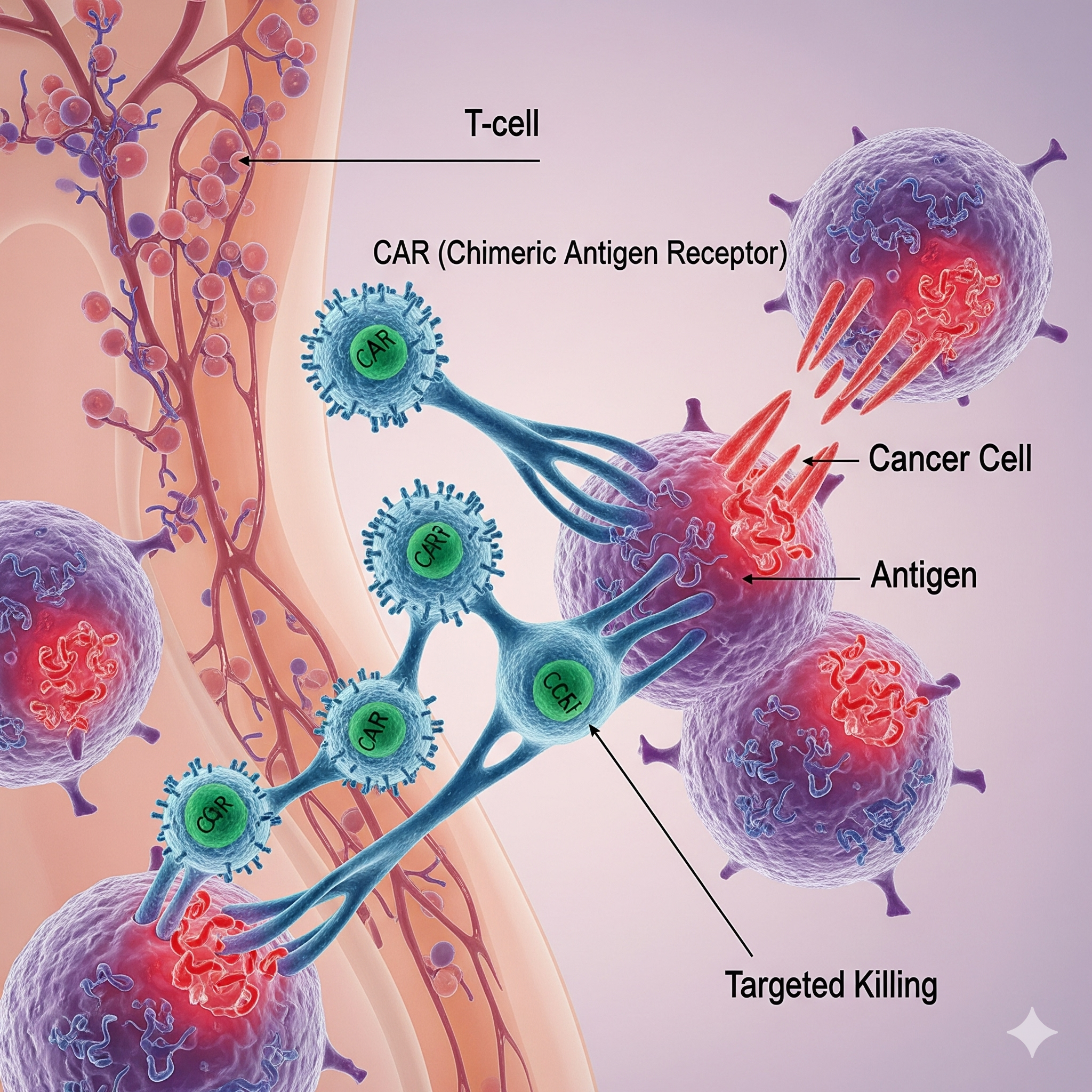
What is CAR-T Cell Therapy?
CAR-T stands for Chimeric Antigen Receptor T-cell therapy. It is a type of immunotherapy in which a patient’s T cells (a type of white blood cell crucial for immune defense) are genetically modified to express a receptor that targets a specific cancer cell antigen.
This receptor — the chimeric antigen receptor (CAR) — allows the T cells to recognize and kill cancer cells more effectively, even if those cells have evaded other forms of immune detection.
How Does CAR-T Therapy Work?
Mode of Action
CAR-T therapy involves several steps:
- T Cell Collection (Leukapheresis)
Blood is drawn from the patient, and T cells are separated out. - Genetic Engineering
In the lab, the T cells are modified to express CARs. These synthetic receptors are designed to recognize a specific protein (antigen) on the surface of cancer cells. For example, CD19 is a common target in B-cell malignancies. - Expansion
The engineered T cells are multiplied in the lab to create millions of CAR-T cells. - Conditioning Chemotherapy
Before infusion, the patient usually receives lymphodepleting chemotherapy to make room for the CAR-T cells. - Infusion of CAR-T Cells
The modified T cells are infused back into the patient, where they seek out and destroy cancer cells expressing the target antigen. - Immune Response and Tumor Destruction
Once infused, CAR-T cells:
- Bind to the cancer cells via the CAR
- Become activated
- Proliferate
- Release cytotoxic molecules (like perforin and granzymes) that destroy tumor cells
- Recruit other immune responses for a broader anti-tumor effect
Diseases Treated with CAR-T Therapy
As of 2025, CAR-T therapy is FDA-approved for several hematological malignancies and is being investigated for others in clinical trials.
US FDA-Approved Indications:
1. B-cell Acute Lymphoblastic Leukemia (B-ALL)
- Target: CD19
- Approved CAR-Ts:
- Tisagenlecleucel (Kymriah) – Approved for children and young adults
- Indication: Relapsed/refractory B-ALL
- Reference: FDA Kymriah Approval, 2017
2. Diffuse Large B-Cell Lymphoma (DLBCL)
- Target: CD19
- Approved CAR-Ts:
- Axicabtagene ciloleucel (Yescarta)
- Lisocabtagene maraleucel (Breyanzi)
- Tisagenlecleucel (Kymriah)
- Reference: National Cancer Institute – CAR T-cell therapy for lymphoma
3. Mantle Cell Lymphoma (MCL)
- Target: CD19
- Approved CAR-T:
- Brexucabtagene autoleucel (Tecartus)
- Indication: Adults with relapsed/refractory MCL
4. Multiple Myeloma
- Target: BCMA (B-cell maturation antigen)
- Approved CAR-Ts:
- Idecabtagene vicleucel (Abecma)
- Ciltacabtagene autoleucel (Carvykti)
CAR-T Therapy: Challenges and Future Directions
While CAR-T therapy has shown incredible promise, it is not without challenges:
- Cytokine Release Syndrome (CRS) – A potentially life-threatening immune response
- Neurotoxicity (ICANS) – Inflammation-related neurological side effects
- Relapse – Some patients relapse due to antigen escape or T-cell exhaustion
- High Cost – Treatment costs remains high
Future Research:
- Solid tumor applications (e.g., glioblastoma, pancreatic cancer)
- Dual-target CARs to prevent antigen escape
- “Off-the-shelf” allogeneic CAR-T therapies
- Combination with checkpoint inhibitors
Conclusion
CAR-T therapy has redefined how we treat certain types of blood cancer, offering new hope to patients who had exhausted all other options. Its success has paved the way for innovative cellular therapies, and ongoing research may soon expand its use to solid tumors and autoimmune diseases.
As we continue to explore and refine this treatment, CAR-T remains a shining example of how personalized medicine can profoundly impact patient outcome
References
- Maude, S. L., et al. (2014). Chimeric antigen receptor T cells for sustained remissions in leukemia. New England Journal of Medicine, 371(16), 1507–1517.
- June, C. H., et al. (2018). CAR T cell immunotherapy for human cancer. Science, 359(6382), 1361–1365.
- FDA News Releases. (2017-2024).
- FDA approval of Kymriah
- FDA approval of Abecma
- National Cancer Institute. CAR T-Cell Therapy Overview